Altitude and Climate Dynamics Reshaping Performance Data in Rugby, Golf, and Tennis
Greta Hoffmann · Aug 5, 2026

Altitude and Climate Dynamics Reshaping Performance Data in Rugby, Golf, and Tennis
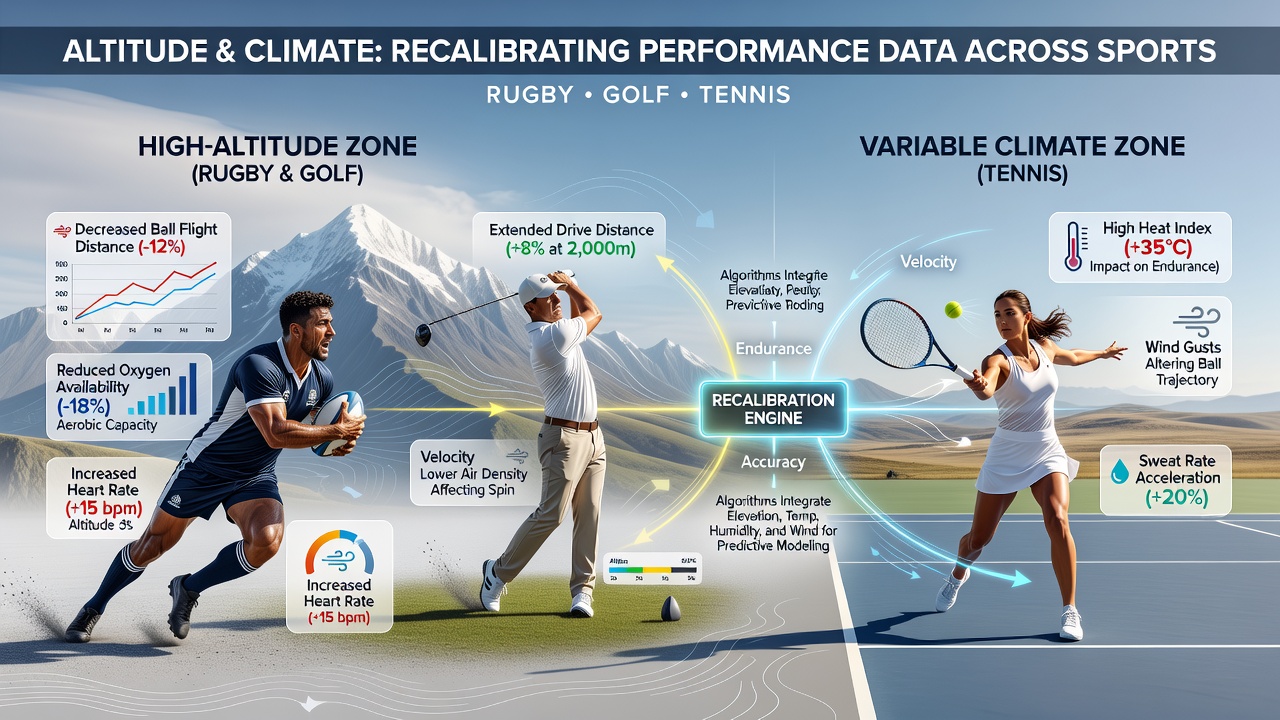
High-elevation venues and shifting weather systems have long altered how athletes generate power, maintain endurance, and execute precision shots across multiple codes, and data collected from professional events continues to quantify these effects in measurable ways. Researchers tracking match statistics at sites above 1,500 meters report consistent drops in sprint distances and recovery intervals during rugby fixtures, while ball trajectory models in golf demonstrate increased carry distances of up to 10 percent when air density decreases.
Rugby Performance at Elevation
Matches staged in locations such as Johannesburg or Mexico City reveal that reduced oxygen availability forces teams to adjust pacing strategies, with studies from the University of the Witwatersrand showing a 15 percent reduction in high-intensity running during the second half compared with sea-level contests. Forward packs experience earlier onset of fatigue, leading to fewer ruck arrivals and altered scrum stability metrics that coaching staffs now incorporate into pre-match planning. Match analysts note that lineout success rates remain relatively stable, yet overall possession retention declines as players shorten their support lines to conserve energy.
Golf Ball Flight and Climate Variables
Golf tournaments held at altitude produce verifiable changes in club selection and scoring averages, as thinner air reduces drag and allows shots to travel farther; tournament records from events in Denver confirm average driving distances increase by 20 to 30 yards for professionals. Temperature fluctuations further modify these outcomes, because warmer air expands and lowers density even more, while humidity levels above 60 percent can slightly counteract the distance gains by increasing resistance. Course managers adjust pin placements and rough heights accordingly, and statistical models used by performance teams now integrate real-time barometric readings to predict scoring ranges for each round.
Tennis Rally Dynamics Under Variable Conditions
Players competing in high-altitude tournaments such as those in Bogota experience faster ball speeds and extended rally lengths because the lighter air allows serves and groundstrokes to retain velocity longer before gravity and drag slow them. Data compiled from ATP and WTA events indicates that unforced error rates drop by roughly 8 percent at these venues, yet overall match durations lengthen due to improved oxygen efficiency among acclimatized athletes. Heat and humidity combinations common in late-summer schedules add another layer, as core body temperatures rise more quickly and force more frequent changeovers that interrupt momentum patterns observed in temperate conditions.
Broader Climate Pattern Influences
Longer-term shifts in precipitation and wind regimes have prompted governing bodies to revise scheduling windows, particularly for outdoor events spanning August 2026 when regional monsoon patterns and jet-stream movements coincide with major tournaments. Performance databases now cross-reference historical wind speed records with point-by-point outcomes in tennis and shot-dispersion data in golf, revealing that sustained crosswinds above 15 kilometers per hour correlate with measurable increases in lateral error margins. Rugby competitions scheduled during transitional seasons show similar sensitivities, as wetter pitches reduce traction and alter tackle completion percentages tracked by league statisticians.
Organizations including the National Oceanic and Atmospheric Administration supply granular atmospheric datasets that sports science teams integrate into predictive algorithms, allowing coaches to simulate conditions weeks in advance. These models also account for diurnal temperature swings that affect early-morning versus afternoon sessions, producing distinct performance baselines that differ from standard sea-level expectations.
Conclusion
Performance records across rugby, golf, and tennis continue to reflect the combined pressures of elevation and climate variability, with statistical agencies updating baselines after each major event to maintain accuracy. Teams and individual athletes who incorporate these environmental variables into preparation protocols demonstrate measurable advantages in consistency and outcome prediction, while governing bodies maintain ongoing data collection to support fair competition standards.