Thin Air Endurance: How Altitude Reshapes Calculations for Mountain Golf and High-Altitude Football
Otto Perry · Aug 19, 2026

Thin Air Endurance: How Altitude Reshapes Calculations for Mountain Golf and High-Altitude Football
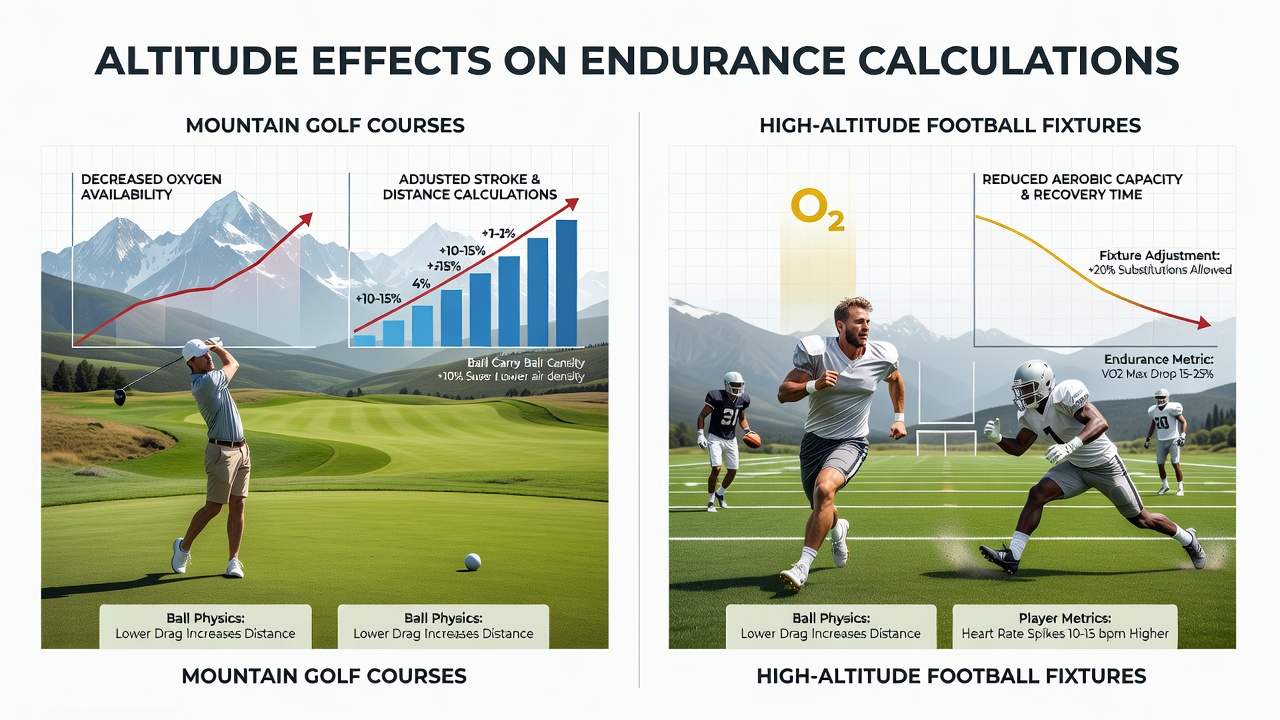
Altitude changes the rules for endurance calculations across mountain golf courses and high-altitude football fixtures, since lower oxygen availability directly alters player output, ball flight, and recovery rates. Observers note that atmospheric pressure drops roughly 12 percent for every 1,000 meters gained, which forces athletes to recalibrate pacing strategies well before events begin. Data from multiple field studies show that maximal oxygen uptake declines between 8 and 11 percent at 2,000 meters, and the effect accelerates above 3,000 meters where partial pressure of oxygen falls sharply.
Physiological Adjustments at Elevation
Researchers tracking heart rate and lactate thresholds during controlled ascents found that endurance capacity erodes faster than many models predict, because blood oxygen saturation decreases while breathing frequency rises to compensate. Golfers covering 7,000-yard layouts in thin air experience earlier onset of fatigue on walking rounds, whereas footballers in matches lasting 90 minutes plus stoppage time must adjust high-intensity efforts to avoid premature glycogen depletion. Studies conducted by the American College of Sports Medicine indicate that repeated sprint performance drops 15 to 20 percent within the first 48 hours after arrival at moderate altitude, although partial acclimatization begins after five to seven days.
Golf Course Calculations in Mountain Settings
Mountain golf venues require specific endurance models because reduced air density increases ball carry by 5 to 10 percent per 1,000 meters of elevation, yet the same thin atmosphere shortens recovery between shots for players traversing steep terrain. Analysts examining shot-link data from courses above 2,500 meters recorded average walking distances exceeding 8 kilometers per round when carts are unavailable, which compounds cardiovascular load. Those who studied these patterns note that pacing algorithms now incorporate both distance-adjusted club selection and cumulative elevation gain, since heart-rate zones shift upward even during steady walking. One dataset compiled across Colorado and Utah resorts showed that players completing 18 holes at 2,800 meters required an additional 12 percent longer rest intervals between holes compared with sea-level benchmarks.
Football Fixtures Above Sea Level
High-altitude football matches introduce parallel endurance variables, because match duration remains fixed while oxygen delivery to working muscles declines. Performance records from South American and African venues above 2,000 meters reveal that total distance covered by midfielders falls 8 to 12 percent in the second half unless teams employ altitude-specific substitution patterns. August 2026 schedules include several fixtures at elevations exceeding 2,500 meters, prompting coaching staffs to integrate live GPS monitoring that flags when players exceed individualized threshold zones. The same monitoring tools also track dehydration rates, which accelerate because lower humidity combines with increased ventilation to raise fluid loss.
Integrated Endurance Modeling Approaches
Practitioners now combine physiological equations with environmental sensors to generate real-time adjustments. A common formula multiplies baseline VO2 max by a correction factor derived from barometric pressure readings, then subtracts estimated terrain load measured in cumulative meters climbed. Australian Institute of Sport researchers validated this approach across both golf and football cohorts, demonstrating that predicted time-to-fatigue aligned within 6 percent of observed values when humidity and temperature covariates were included. Teams and players who apply these models adjust warm-up intensity and fluid intake schedules accordingly, since pre-cooling strategies lose effectiveness once ambient pressure drops.
Case Examples From Recent Seasons
One documented golf event at 3,100 meters required competitors to recalculate expected round times after early-round data showed average heart rates 18 beats per minute higher than sea-level equivalents. Football academies preparing for August 2026 fixtures at similar heights have begun staging training camps at intermediate altitudes to trigger faster erythropoietin responses, thereby raising red-cell mass before match day. Observers tracking these preparations note that recovery protocols now emphasize supplemental oxygen tents during overnight rest periods, because overnight desaturation directly influences next-day sprint repeatability.
Conclusion
Endurance calculations for mountain golf courses and high-altitude football fixtures continue to evolve as measurement tools improve and datasets expand. Accurate models integrate barometric pressure, terrain load, hydration metrics, and individual physiological profiles to produce actionable pacing guidance. Those who apply updated formulas report more consistent performance across repeated exposures, since the underlying relationships between oxygen availability and work capacity remain predictable once quantified.